Resemblances

I strongly resemble my mother. In school, people always knew if she showed up there, and the news would reach me: “Your mother’s here. She was in the hall heading to the office.” What? How did they know? “You look exactly like her.”

I want to tell you what my father looked like. You can’t really see him by looking at me. He had curly hair, which was brown, a regular brown and not dark like mine was back while he was alive. When he was in the sun, there was almost a red hint. Whenever he grew a moustache and beard, red would show up along with the brown. Dad’s eyes were blue. Sometimes they appeared greenish, or grey. We girls used to tell Dad that they changed depending on what color shirt he wore. That he had “mood eyes.” On the last day I saw him alive, his left eye was such a brilliant blue, I was startled. I felt guilty, too, for softly pulling up his eyelid to peek beneath it while he was so deeply asleep. I didn’t see a color that blue until nearly 20 years later, when I visited the Bahamas. The water was impossibly blue, like Dad’s eye.

My father had a receding hairline, hairy chest and arms, and hair in his belly button. On Saturday visits with him, he’d sometimes nap on the murphy bed in his apartment while we girls watched TV beside him. While he was asleep, we’d roll up his pantlegs and roll down his socks, giggling at his hairy white legs. Then we’d peek into his bellybutton for lint. He’d snore slightly, until our fussing over him woke him up. Lying down, Dad’s ribcage seemed large. His voice rumbled up out of his chest when he spoke. He was a man of average height, not heavyset, with good posture, and when he needed to command attention, he could. He could have been a police officer, but he wasn’t. He worked in the public schools and liked people. They liked him, and his voice. Usually when he conversed with others, they shared a chuckle before parting ways.

Dad was fair, as a British descendant, and his skin was sensitive to anything harsh. When he worked at a deli counter for a summer, wrapping meat in paper and string, trying to break the string cut his hands. He was the only one who had to reach for the scissors. I remember the time he got burned from a grease fire on the stove. When he moved the pan into the sink, flames wafted over the back of his wrist and gave him 3rd-degree burns. I’d just had first-aid training in 6th grade at school, and I forced him to let me examine his hand. The skin was red, and purple, and blue, with an open wound. Dad had wrapped it himself, and I insisted that we take him to a doctor. Dad’s teeth were slightly crooked and the top canines were pointed. We liked it when he bared them a little, and called him a vampire.

I don’t look like my father. My hair was dark, like my mother’s, before it went salt-and-pepper. My eyes are so dark a brown as to be nearly black. My coloring is not as pale as his, though lighter than if I weren’t sensitive to the sun, so perhaps I inherited something of my father’s sensitive skin. Here – where I mostly take after Dad is in my hands. I’m left-handed like he was, and my palms are somewhat square like his. The tips of my fingers aren’t elegantly oval like my mother’s but spatulate, like Dad’s. On a sidewalk in a suburb of Michigan, there are four handprints pressed lightly into the cement: Dad’s, Mom’s, my older sister’s, and mine. The mark nearby is from my younger sister’s shoe when she twisted away, afraid to let Mom put her hand into the wet cement beside ours. 25 years after Dad died, I placed my hand in the print Dad had left. His hand appeared only slightly larger than mine, surprisingly. When I remember holding his hand, warm and slightly moist, it always seemed much bigger. Oh – my thumbs are his. Just after he died, I was reading a book. I noticed my hands holding the pages open, noticed my right thumb. I cried.
Finding myself

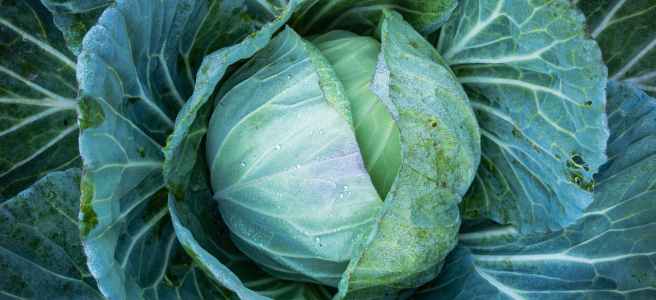
I am 60. Have I found myself yet? My parents used to tell us that we children were found under a cabbage leaf as babies, before Mom was ready to sit us down with the Encyclopedia Britannica volume that showed the nude on one half and the other without flesh. Or they’d say we were found in a shoebox.

When I gardened, I never came upon myself beneath the leaves of lettuce or rhubarb. Not under a leaf in the grapevines that hid small green orbs that looked made of wax, and tasted so sour before they were ripe.

I’ve not stumbled upon myself in an old shoebox tucked back into the shadowy corner of a closet. I’ve looked plenty of other places, too, just to be thorough: not in the breadbox or the drawer beneath the oven with the pots and pans. Not in the garage with the odor of gasoline and the hot motor of the lawn mower after a turn around the yard. I haven’t found myself in the hollow of a guitar or along the silvery tube of a flute. I looked for myself in the packages that arrived each month by mail, first with a kit for making a new craft, and later an LP or cassette tape from Capitol Records or recordings of The Academy of St Martin in the Fields that taught me to love Classical music.

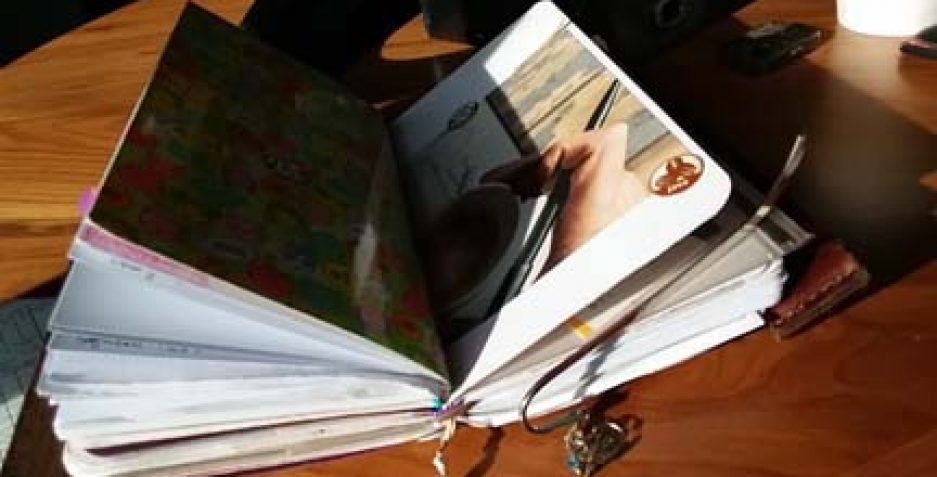
Perhaps I find myself inside of notebooks, tucked between leaves of paper. Perhaps it isn’t the 3-dimensional me, but a flat, paper-doll-type approximation of who I am. The closest representation of how I appear most of the time. I take up a pen and tentatively make a mark on the paper image. I might feel self-loathing today and add a mustache, a small dark rectangle like Hitler or Groucho Marx. I might try to draw clothing that feels like myself, a black leotard, a red pashmina wrap.

Finding myself might be the greatest gift of my life, but I suspect that there’s a fear it will be a disappointment, a map of how far I have yet to journey before I am in the neighborhood of my true self. Perhaps that fear makes me set myself aside in a shoebox for now, in a shadowed corner.

The necessary building of unnecessary stairs

My father is rebuilding the wooden steps leading to the front door. A tree branch fell in yesterday’s storm, and splintered the original stairs to bits. I’ve watched Dad build with wood before. He can knock together small projects easily. There have been other, larger ones, too, which I have never seen. At the high school downtown, Dad has directed students in constructing stage sets for the theater department’s plays. It’s a part of his life I don’t know. I’ve never seen a production there, nor will I even see a photograph of his work, until I’m an adult, and he is long dead.

I want to watch Dad as he kneels to his work on the front steps, but this day he seems not to welcome it. It isn’t so much his brusque tone, as the tension in his shoulders and arms as he moves. He drops the small bundle of unpainted boards onto the cement apron, and the hollow clatter feels like a dismissal. I will not see Dad wield a hammer and nails again, but I remember the sound of metal hitting metal as he proceeds, an angry sound.

The splintered steps are necessary. Mom has warned us girls against going through the front door until Dad tells us it is safe. The fall from the stoop to the cement apron isn’t far, except for the legs of a 7-year-old-child. Something about not having front steps feels like an emergency. We have the back door and its postage stamp of porch, but from the gravel street in front of our house, the missing porch steps are alarming, like the sight of a broken-out front tooth. An unacceptable gap that is something to hide. When I lose a front tooth just before school picture day, Mom tells me sternly that I am not to smile with my lips parted when the photographer asks me to say, “cheese.”

Dad has to build the steps because there is no one else to do it, because hiring somebody costs money, because he is the one who is supposed to fix things. Usually, Mom is the one to point out what my father is to fix. Either Dad doesn’t notice the problem, or he is willing to tolerate the broken or imperfect much longer than my mother can live with it. Dad can solder, tack down a loose shingle, saw, and hammer, and glue. He can put things together. But he’s not built for labor, with his sensitive hands, fragile skin, and history of enlarged heart. I have rarely seen him run, never hit a baseball, nor do lifts on a chin-up bar. I remember the hand grip strengtheners in his first apartment after the divorce, and the chest expander with rows of resistance springs connecting two handles. I remember my sister and I seated on the toboggan, crying out for Dad to pull us and run! and the wheezing way his voice came back to us, “I am running!”

My father has to rebuild these steps, even though, as it turns out, he won’t need to use them for much longer. One thing that is unusual about the broken porch is that neither Mom nor Dad was the one to point it out. It was my sisters and me who, where we were in the living room near the front door, heard the crash of the tree branch just after the boom of thunder. I remember the rattle of the screen door when the branch struck it on the way down. We ran to the windows to see what was trying to break in. Wet black bark and leaves loomed, reaching. It looked like an entire tree had fallen across the front door. But Mom and Dad didn’t hear it, or our shrieks of surprise. It was a shock to go into the kitchen and see only the looks of annoyance on their faces. That was the first time I recall my parents in deep discussion, apparent serious talk that seemed to shut out all other things. Talk that was more important than the house falling down. Perhaps that was a lead-up to Dad’s leaving. I didn’t think of it as a clue, when I looked back on it later. There had been plenty of others: tiny quarrels which Dad lost quickly, issues about money, issues about providing better, issues about seeing what things Mom saw were wrong. The deep talk in the kitchen that day was secondary to the chaos at the front door.

I didn’t see Dad’s cross undertaking of rebuilding a set of steps he wouldn’t use as a sign of the change to come, either. He finished them, cut up the wayward branch, cleared things away in his usual manner. When he moved out of the house, I was as blindsided as my parents had been by lightning hitting the tree and bringing a branch down onto the steps, just missing the house. An impact concealed beneath ongoing thunder.

I am one of those people who…

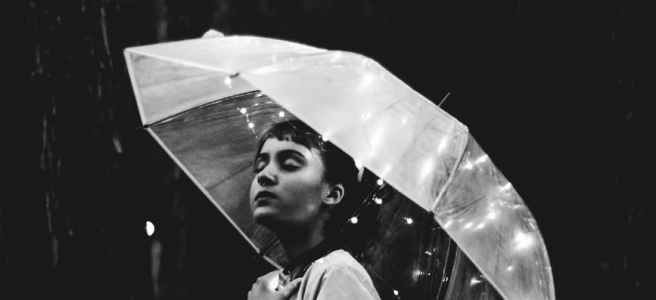
I am one of those people who still remembers how I felt in 1970, walking up the hill from the corner of Pomona and Lennane, past the house where the German Shepherd, Flicka, nipped my fingers when I wrapped them around the wire of her kennel run. I can smell the wet grass and what I imagined was the odor of long pink and purple bodies of earthworms drowned on the sidewalks. The sound of rain pattering on my plastic umbrella. The darkened bark where it was wet on the trees.

I am one of those people who thinks it is important, if I still remember it. Or, if not important, it is somehow useful. Once in a while I will bring up one of these memories to my sisters, so we can feel the chilly moist spring air coming up from Lola Valley Park together. And they will usually travel back with me. Do C and V carry the pale gravel road in weak summer sun with them as I do? Is the sound of the crickets and cicadas a meaningful buzz in their heads as often as it is in mine?

Some people don’t care to remember, and I am not one of those kinds of people. 

“I would never want to go back. I wasn’t very happy there.”

Yes, we were all unhappy in our own ways on that street overlooking the park. In one sense or another we were prevented from being ourselves. Our parents didn’t know any better.

But what I remember is hanging sheets on the clothesline in your yard, having memorized my lines and practiced the song we made up for Earth Day, and the excitement of knowing that when we emerged from behind the white-and-flowered curtain we were some other children, for a little while anyway, and not even children but performers come to these parts to entertain and enlighten. I just wanted to sing. Who cares that we only charged a nickel, and even without a nickel, anyone could come and watch?

I remember sitting in the back yard singing, “Little Tom Tinker Sat On a Clinker,” louder and louder, our voices goading each other on, bouncing from the side of Danny N’s garage and then from the side of Danny O’s garage, and back again. We sang faster and faster and faster, mixing up the words and laughing, until the one Danny’s grandmother – who only spoke Canadian French – appeared at the back screened door in a frilly white robe, frightened because she thought someone was hurt and crying. And her Danny tried to tell her we were only singing, only having fun. 

Would you trade that for anything?

I remember reading Ray Bradbury’s book about writing, in which he said that the place where he grew up was not an important one, except in the sense that he was born there. Bradbury took those autumn days and nights of darkness and made his stories out of them. No one but he could have written those books, and it was because he still remembered what he felt like back there and then. He was one of those people who didn’t throw away the way he responded to the world he found himself in, though I’m sure he wasn’t happy there all of the time.

Was any of it important?

What I really want to say is that all of this makes me hope anyone who has chosen to forget the spring rain because the dead earthworms made them feel queasy might look instead at the new blossoms coming up on the Chestnuts’ cherry tree.

lifeinonescene

I crouch on a carpeted step where the stairway ends in the kitchen. I’m near the bottom, with my curly-haired little sister below me. Above me, I can just sense my older sister’s breathing, as if she’s invisible.

My father speaks: “I’m not going to be living here any more.” My legs press against the scratchy, low-pile synthetic carpet, dark brown. Do I smell the vomit of those nights when my sister threw up on the stairs? My mouth is filling with saliva. Do I want to vomit, or to cry? My eyes are burning, dry.

I think my head is pounding with the thud of my heartbeat. I’m afraid I won’t be able to hear what Dad is saying.

I have words in my mouth but I know I’m not supposed to say them. Dad is the one who is supposed to talk. I know this, because Mom is quiet. He is not saying enough, so she is glaring at him. He is not saying enough for me to understand what this means.

“I’m not going to be living here in this house with you any more.” I am smothered by the vague smell of vomit. The stairway feels like a tunnel and the space is getting too tight, closing in. It’s like a dream where I’m pinned in place; I can’t go up or down.

Heading out…

Please trust yourself: in writing, in Zen, in everything.

— Natalie Goldberg

These posts are from writing practice, minimally edited, if at all.

They’re fresh out of my mind. Or I am.

I feel like I did when I was 17, sitting in the navy blue stick-shift Chevette that Pop used to let me drive to work. I felt powerful when I drove it, shifting gears. The moment seemed so full of possibility, as if I could drive into my future that very day. I didn’t particularly know what direction I might be heading, but I had no serious concern about that part of it.

Just start.