On the day the world ends

On the day my father died,
I thought the world should end.
It was late August, more summer to come,
but I wanted the bleakness of cold.
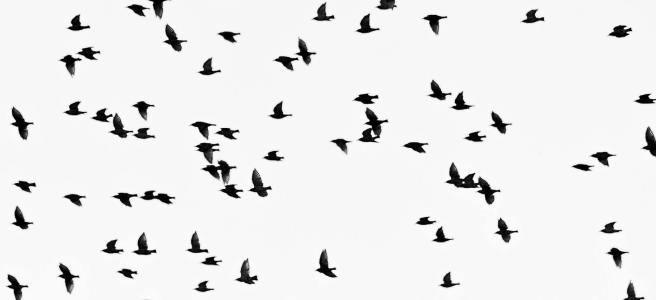
In the afternoon I watched a scatter of small birds
whirl in the sky above my head
and I thought I should dissolve
into tiny specks like they did.

On the day the world does end,
perhaps there will be no death.
Perhaps there will only be dissolution,
whether of the chair where I sit
or the walls around me, or forests of trees,
like a reverse Fall.

Maybe I won’t be sure whether all is ending
just for me, or for every living thing.
On that day, it may happen so slowly
that there’s not even a sense of alarm.
Some believe in specific signs,
events that were foretold for centuries,
foretold for the comfort or guidance of human souls.
I never embraced those symbols.
I don’t know what the end of the world
really means. Will there be
no more suitable air to breathe?
Will the sun go silent and the mouths of the birds 
go dark?

My friend wanted to die
with curiosity in his eyes.
I don’t think it turned out that way.
But I’m curious about the way the world could end.

And yet, I don’t think I want to know.
The gut punch of shock, disappointment, disbelief
that’s hit me before
must be nothing to the loss
of all we recognize. Or will we
gain it all, becoming one with
the One? Perhaps that will feel the same,
leaving us gasping, if we can breathe,
screaming, if we have throat and ears. 
Even if it’s great joy,

I don’t think I want to know.
Imagine a woman

Imagine a woman

begins to read her own life

from the beginning, and finds

that much is missing, not to be replaced.

Imagine she turns pages over,

looking for the mother, the father

who would nurture and nourish

the infant the woman had been.

Imagine the woman does not turn

away from her story, but reads on,

and when she cries, imagine

the way she holds herself

in her own arms

gently.

Imagine a woman with a book

of her own life

that has no appendix, no code

to connect this wound

to that scar, that soreness

to this ease. And the woman

does not stop reading.

She places a finger lightly on each black shape

along the line, determined to feel

the hardest angle, the sharpest

point at each sentence’s end.

Imagine the woman presses harder,

then looks at her fingertips

imprinted with every true word.

Imagine the woman takes the book

in both hands,

sets it firmly aside, then

taking ink and pen in hand,

she opens a fresh notebook,

and imagines a woman

who knows what words

are needed to make the first book

into a song.

Where am I from?

I am from this green place, this wet place, that place of weak sun, of strong sun. I am from the shore where there is sand, where there are rocks not worn by the water. I am from this place where we speak with our mouths, we speak with our hands, with our hearts.

I am from places which I have never left. I’m from the language of my homeland. I am far from the language of my birth. I am from a town that had gravel streets. I’m from paved highways. We ate the most usual foods there, we opened boxes and cans and with heat we said we were cooking. We fed ourselves less than other people did. We sang more than other people did, and did it alone if necessary, and in the snow.

I am from telephones on the wall, and musical boxes on the table, and one television against the inner wall separating the living room and the basement stairs.

I am from staring at the moon. Where I began the earth was rock hard, and then soft as a marsh. The traditions I am from are so arcane we didn’t know what they were; they looked like nothing, like a non-Norman Rockwell, like a family broken, a family together.

I am from this earth, where I awoke this morning and at least a hundred other mornings, and I look around me with eyes wide each day, asking again and again: “Where am I from? Where am I from? Where did I ever come from, and when?”

Heading out…

Please trust yourself: in writing, in Zen, in everything.

— Natalie Goldberg

These posts are from writing practice, minimally edited, if at all.

They’re fresh out of my mind. Or I am.

I feel like I did when I was 17, sitting in the navy blue stick-shift Chevette that Pop used to let me drive to work. I felt powerful when I drove it, shifting gears. The moment seemed so full of possibility, as if I could drive into my future that very day. I didn’t particularly know what direction I might be heading, but I had no serious concern about that part of it.

Just start.